

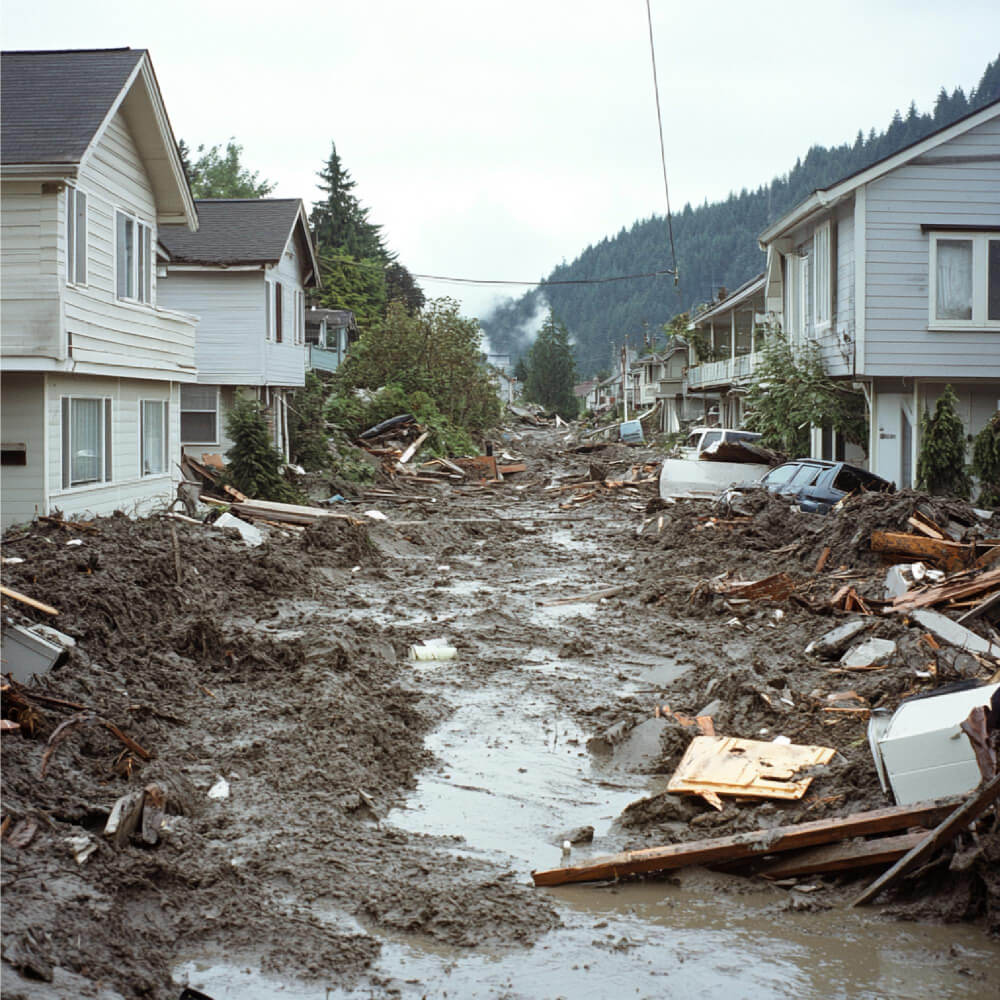
Understanding if Flood Insurance Cover Mudslides
The question of does flood insurance cover mudslides arises often because flooding and slope failures can occur during the same weather event. Under National Flood Insurance Program guidelines, flood insurance coverage applies to water overflow that inundates land and structures. However, mudslides fall under a different classification known as earth movement, which is treated separately from flood-related damage.
Mudflows are sometimes included under flood insurance when water-driven debris moves across land in a river-like flow. This distinction is important because mudslides are defined as the collapse or movement of saturated earth down a slope, often without a flowing water channel. As a result, standard flood insurance policies generally exclude mudslide damage.
This separation creates confusion for homeowners who assume all ground-level water disasters fall under one policy type. In reality, insurance rules rely on how the event begins rather than the visible damage it causes. When heavy rain triggers soil saturation that leads to slope failure, the resulting damage may fall outside flood insurance coverage.
Understanding this classification helps homeowners evaluate risk more accurately. It also highlights the importance of reviewing policy terms carefully before relying on flood insurance alone for slope-related hazards that involve soil movement and structural impact risks.
Difference Between Mudslides, Mudflows, and Flood Damage
Clear distinctions between mudslides, mudflows, and flood damage play a major role in determining insurance eligibility. Flood damage typically involves rising water that spreads across land surfaces and enters structures. Flood insurance coverage applies to this type of water intrusion under federal program guidelines.
Mudflows occur when water mixes with loose soil and debris, creating a flowing mixture that moves along a defined path. These events may be covered under flood insurance when they meet specific federal definitions tied to water-driven movement.
Mudslides, however, involve the sudden collapse of saturated earth or rock down a slope. This movement is classified as earth movement rather than a flood event. Because of this classification, does flood insurance cover mudslides becomes a negative answer in most cases.
The distinction is not based on damage severity but on the cause of movement. A rainfall event can trigger both flooding and slope failure in the same area, yet insurance policies separate them into different risk categories.
Homeowners often misunderstand this difference, leading to gaps in protection after disasters. Reviewing how each event is defined under insurance rules helps clarify why certain losses fall outside flood insurance coverage and may require additional policy options for broader protection against natural ground movement hazards.
Why Mudslides are Excluded From Flood Insurance
Mudslides are excluded from standard flood insurance because they are categorized as earth movement rather than water overflow events. Insurance frameworks focus on the mechanism that initiates damage rather than the presence of water during the event.
Flood insurance is designed to respond to situations where water rises, spreads, and enters structures from external sources. Mudslides involve gravitational collapse of soil that has become unstable due to moisture or environmental changes. This difference in origin separates the two risks within federal insurance guidelines.
Even when heavy rainfall contributes to slope failure, the resulting mudslide is not treated as a flood event. This classification is consistent across federal underwriting rules, which exclude landslides and similar movements from standard flood insurance coverage.
The exclusion often surprises homeowners living in hilly or wildfire-affected regions where soil stability changes rapidly. Wildfires can remove vegetation that normally anchors soil, increasing the chance of sudden slope collapse during rain events.
Insurance Options Beyond Flood Insurance Coverage
Since flood insurance does not typically cover mudslides, homeowners may need additional policy options to address earth movement risks. Specialized coverage such as difference in conditions insurance may include protection for landslides, slope collapse, and related hazards. These policies are designed to fill gaps left by standard homeowners and flood insurance plans.
Standard homeowners insurance also excludes most earth movement events, which leaves many properties exposed when slopes fail due to heavy rainfall or environmental changes. Private insurers sometimes offer broader coverage options that combine multiple natural disaster protections under a single policy structure.
Flood insurance cost considerations often influence decisions about additional coverage. Higher-risk areas may face increased premiums, especially when properties are located near steep slopes or wildfire-affected terrain.
Homeowners evaluating coverage options should consider both water-related and ground movement risks when selecting insurance protection. This approach helps reduce exposure to unexpected repair expenses following natural disasters that involve both flooding and soil instability.
Understanding available insurance structures supports more informed decision-making, particularly for properties located in regions where rainfall, erosion, and terrain conditions combine to increase the likelihood of slope failure events that fall outside traditional flood insurance coverage rules.
Risk Factors That Lead to Mudslides
Several environmental and human-related conditions increase the likelihood of mudslides. These factors often act together, weakening soil stability and making slopes more vulnerable to sudden movement during storms or periods of saturation.
- Heavy rainfall: Prolonged or intense rainfall saturates the ground, reducing soil strength and causing it to shift downhill under gravity.
- Rapid snowmelt: Sudden melting in mountainous regions releases large volumes of water into the soil, creating unstable slope conditions similar to heavy rain events.
- Wildfire damage: Burned vegetation removes natural root systems that hold soil in place, leaving slopes exposed and more likely to collapse during rainfall.
- Water-repellent soil layers: After intense fires, soil can develop hydrophobic layers that increase runoff instead of absorption, raising slope pressure.
- Soil composition: High clay content or loose sediment structures weaken easily when exposed to excess moisture, increasing movement risk.
- Construction activity: Excavation, grading, and land development can destabilize slopes by altering natural support and drainage patterns.
- Deforestation: Removing trees and vegetation reduces root reinforcement, making soil more prone to erosion and collapse.
- Poor drainage systems: Inadequate water flow control allows moisture to accumulate, increasing soil weight and reducing slope stability over time.
Speak With Insurance Guidance That Fits Real Risk
Understanding whether flood insurance covers mudslides is only part of managing property risk. Coverage decisions depend on location, terrain, and how different policies classify natural disasters. At RetireMax Insurance, we review these details with homeowners, explain coverage gaps clearly, and help align insurance options with real property conditions. With more than 30 years of experience and no broker fees, our team focuses on clear communication and practical support that helps families choose protection with confidence and clarity.
Speak with our team to review your coverage options, understand your risk exposure, and get straightforward answers about flood insurance and related protections.
FAQs
Does flood insurance cover mudslides?
Flood insurance does not typically cover mudslides because they are classified as earth movement rather than flooding under federal guidelines.
What is the difference between a mudslide and a mudflow?
A mudflow is water-driven and may fall under flood insurance rules, while a mudslide involves soil collapse and is usually excluded from coverage.
Can homeowners insurance cover mudslides?
Standard homeowners insurance usually excludes earth movement events, including mudslides, which may require specialized insurance options.